Posts

An Other Voice: English Literature from Nepal

Image
An Other Voice: English Literature from Nepal Deepak Thapa, Kesang Tseten, eds Martin Chautari, Kathmandu, 2002 Rs 275 Short stories by Mani Dixit, Joel Isaacson, Sushma Joshi, Peter Karthak, Sunil Nepali, Greta Rana, Manjushree Thapa, Kesang Tseten and Samrat Upadhyay. Poetry by Wayne Amtzis, Hannah Chi, Padma Prasad Devkota, Tsering Wangmo, Dhompa, DB Gurung, E Ann Hunkins, Manju Kanchuli, Tek B Karki, Kesar Lall, Yuyutsu RD Sharma and Abhi Subedi. http://archive.nepalitimes.com/news.php?id=10577#.XAd4cyN95JU
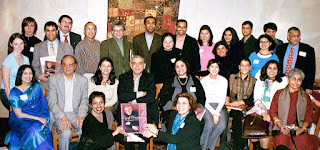
Book reading with producer Ishmael Merchant, of Merchant and Ivory Productions

Image
NYC: Fri, Nov. 22: DINNER: A South Asian Journalist Association Newsmaker Dinner with filmmaker and  author Ismail Merchant. He was launching his book at this event. I'm wearing the blue sweater and in the second row on the right.  Ishmael was full of fun, laughter and life.  His stories about how he made his films were fascinating, and inspired me to make my own films. 

REVIEW: Death of Vishnu

The Death of Vishnu The Kathmandu Post, February 24, 2002 By Sushma Joshi A man lies dying on the stairwell of a crumbling tenement house in Bombay. The twisted plot of The Death of Vishnu, mathematics professor Manil Suri’s creation, originates out of that, spiraling like a stairway into social realism and the myths of Bollywood. Drawing from the non-linear genre of Bombay film scripts, and the hyper-linked, multi-plot structure of Hindu mythology, the story works its way slowly but inevitably into the unforgiving politics of religious violence and communalism that dominates the politics of contemporary India. While Vishnu lies delirious, in the throes of his last sexual fantasies before death, two Hindu neighbors play out their day to day rivalries and petty jealousies on his dying body, quarreling over who should pay for the ambulance. This middle class struggle is just another in a long tradition of jealousies and fights in their shared kitchen. Their husbands, meanwhile, ineffectu...

REVIEW: Bitter Gourds Short Story Collection

THE BITTER TRUTH Sushma Joshi, February 2002, Kathmandu Post The stories are small, but with a spicy aftertaste that could be from nowhere else but the subcontinent. Talat Abbasi's Bitter Gourd and Other Stories is a collection of nugget sized, delectable tales laid out, in typical desi fashion, amongst the detritus of social stratification, family ennui, economic marginalization and diaspora. Gently dousing her stories with a generous portion of irony and satire, the Karachi born writer brings to the fore the small hypocrisies and the mundane corruptions of everyday life in Pakistan. Whether dealing with a birdman or a poor relation, a rich widow or an immigrant mother, Ms. Abbasi touches the mythic heart that ticks besides all these caricatures. The ghostly narrative influence of Virginia Woolf, with a pinch of Victorian lit thrown in for good measure, is discernable, although most of the voices are centered around the "how kind, how kind" echoes of South Asia...

REVIEW: Asian Writers Meet Debating "Asian-ness"

Asian Writers Published in the Kathmandu Post, Feb 11, 2001 This event took place at the New York Times building in NYC, and was sponsored by that newspaper. It was a toss up between Derrida and Jumpha Lahiri, and I chose Jhumpa. It was the seventieth year for the Father of Deconstruction, and the philosopher sat patiently in a crumbling synagogue with Gayatri Spivak generating random, disconnected sentences on one side, and another woman, fashionably attired in bobby pins and rhinestone glitter on her hair, talking about her new book called Stupidity, on the other. It looked like the old man would not even get a word in edgewise, keeping with the best traditions of deconstruction. So I made a quick decision to jump on the subway and head uptown, where the New York Times was holding a panel on new Asian writers called Asian Voices. Jhumpa might be able to provide more insights on life, truth and reality than the panel on deconstruction could at thi...

SAMAR Magazine: Waiting for Rain

Image
SAMAR magazine published my story Waiting for Rain in Issue 13: Come Africa About SAMAR Magazine  SAMAR (South Asian Magazine for Action and Reflection) strives to bring forth critical and dissenting voices related to South Asia and the diaspora through analytical essays, editorials, journalism and the arts.  SAMAR's fundamental commitment is to promote social and economic justice.  SAMAR was launched in 1992 as a print magazine to give voice to progressive and radical perspectives on issues affecting the South Asian community such as communal violence and the plight of working class South Asians. You can find the story archived in the South Asian American Digital Archive (SAADA).

'Cheli-Beti': discourses of trafficking and constructions of gender, citizenship and Nation in modern Nepal

Image
I make absolutely no profit off this, but if you really want to read my article, you can get it from Routledge. Here is the journal South Asia . Author: Sushma Joshi Affiliation: New School University, New York DOI: 10.1080/00856400108723442 Publication Frequency: 3 issues per year Published in: South Asia: Journal of South Asian Studies, Volume 24, Issue s1 2001 , pages 157 - 175 Subject: South Asian Studies Formats available: PDF (English) Also incorporating: South Asia: Journal of South Asian Studies (Series 1) Article Requests: Order Reprints : Request Permissions